What is the C-Spot? A Scientific Breakdown
The term “C-Spot” is not a new erogenous zone; it is shorthand for the entire clitoral complex, an internal–external organ that wraps around the vagina like a wishbone. While only the glans (the pea-sized bump visible under the hood) is commonly discussed, MRI studies published in the Journal of Sexual Medicine (O’Connell et al., 2005) show that the clitoris extends 9–12 cm internally, with bulbs that swell during arousal and crura (legs) that hug the urethra and anterior vaginal wall. The C-Spot therefore includes the glans, hood, bulbs, crura, and the neurovascular bundle that feeds them—collectively containing 8,000–10,000 sensory nerve fibers, double the concentration found in the glans penis. Understanding this anatomy reframes “vaginal” orgasms as indirect clitoral orgasms, a nuance that aligns female sexual response with the organ’s true size and placement rather than with mythical interior buttons.
What is the C-Spot? Myths vs. Medical Facts
Popular culture still peddles the idea that the C-Spot is a tiny magic button that guarantees instant climax, or that only certain women possess it. Peer-reviewed anatomy debunks both claims. First, every cis-female body has the same clitoral complex; variation lies in vasculature and nerve density, not presence. Second, the glans is highly sensitive to direct touch, yet roughly 70 % of women in a 2017 Canadian Journal of Human Sexuality study preferred indirect or circulatory stimulation, indicating that “button” imagery is misleading. Finally, the C-Spot is not a separate entity from the G-Area (anterior vaginal wall); instead, stimulating the latter simply compresses the internal clitoral bulbs. Recognizing these facts reduces performance anxiety for both partners and shifts the sexual script from hunting a spot to engaging an entire organ system.
“What is the C-Spot?” – Your Top 10 Questions Answered
1. Is it real? Yes—if you mean the whole clitoral complex. 2. Can I see it? Only the glans; bulbs and crura are internal. 3. Does size affect pleasure? Nerve density matters more than absolute size. 4. Is squirting linked? Possibly; the bulbs flank the urethra. 5. Can it be desensitized? Temporary saturation yes, permanent damage rare. 6. Does hormones change it? Testosterone enlarges the glans; menopause may reduce fullness. 7. Best sex positions? Those that create external–internal pressure: cowgirl, doggy with manual front stimulation. 8. Toys? Air-pulse for glans, curved insertables for bulbs. 9. Pain reasons? Hood adhesions, vulvodynia, or prolonged suction. 10. Still unsure? A pelvic-floor physiotherapist or certified sex educator can provide individualized guidance, and websites like AASECT.org maintain searchable provider lists.
Mapping the C-Spot: Anatomy & Location Guide
Begin by locating the glans clitoris: follow the inner labia upward until they meet under the mons—where the small hooded bump emerges. Gently retract the hood to see the shiny epithelium; this is the external gateway. Internally, slide a lubricated finger 2–3 cm into the vagina and press upward toward the pubic bone; the textured ridge you feel is the urethral sponge, but the pressure also lifts the clitoral bulbs. Two centimeters lateral on either side you can sometimes palpate the engorged bulbs during high arousal—they feel like soft, warm pillows. Finally, the crura travel deeper, flanking the pelvic bones; they become taut when the woman is close to orgasm. A 3-D silicone model (available through sex-positive retailers) or the free Visible Body web atlas can help visualize these structures if live exploration is paused.
How to Stimulate the C-Spot: Techniques Revealed
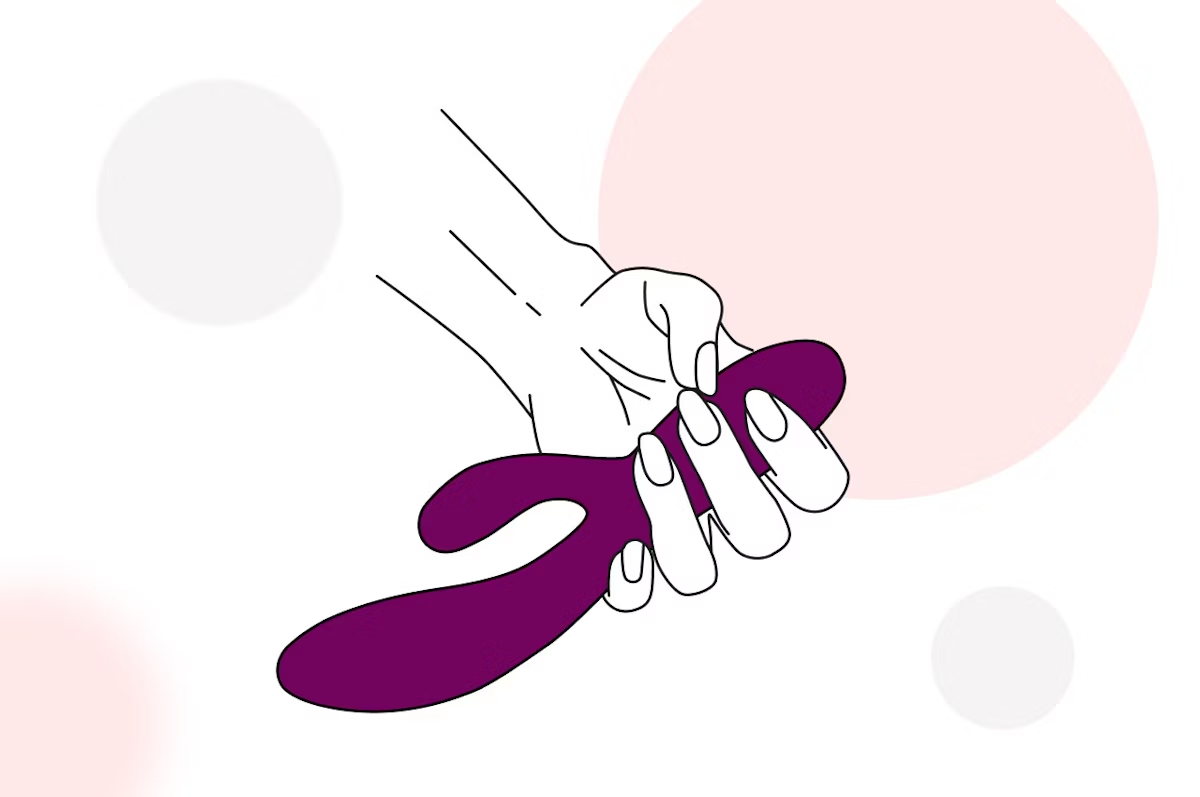
Start with broad, indirect pressure: use the pad of your index and middle fingers to make slow clockwise circles over the hood, avoiding direct glans contact until arousal heightens. Increase speed gradually, then layer a come-hither motion 2–3 cm inside the vagina, synchronizing external and internal rhythm. For toy users, combine an air-pulse clitoral stimulator (Womanizer, Satisfyer) with a slim curved G-area vibrator; set the internal arm to a low constant pulse while the external nozzle provides intermittent suction—this dual activation recruits both the bulbs and the glans nerve plexus. During intercourse, choose positions that maintain pubic alignment: in missionary, place a cushion under her hips and rock rather than thrust; in cowgirl, she can grind forward–back instead of up–down, keeping her clitoral root compressed against your pubic bone. Lubrication is non-negotiable—silicone-based lube reduces friction burn and sustains glide for the 10–20 minute stimulation window many women need.
C-Spot vs. G-Spot: Key Differences You Need to Know
The G-Spot is not a distinct organ; it is the area where the urethral sponge, internal clitoral bulbs, and surrounding vasculature can be felt through the anterior vaginal wall. The C-Spot, by contrast, is the entire clitoral complex, most of which is invisible. Functionally, G-Area stimulation works because it compresses the clitoral bulbs against the vaginal ceiling, whereas direct C-Spot attention (glans or hood) triggers the pudendal nerve, producing a sharper, more localized orgasmic sensation. A 2020 Sexual Medicine Reviews meta-analysis found that 56 % of women reported climax from external glans stimulation alone, while only 18 % reached orgasm solely through G-Area pressure, underscoring that the C-Spot is the more reliable pathway. Rather than choosing sides, treat the G-Area as the internal gateway to the C-Spot, and cycle between focused glans circles and deeper anterior pressure to recruit overlapping nerve pathways—pudendal, pelvic, and hypogastric—maximizing intensity and duration.
Unlocking Pleasure: Why the C-Spot Matters for Climax
Neuroimaging studies at the University of Groningen show that clitoral stimulation lights up the somatosensory cortex, amygdala, and anterior cingulate—regions tied to pleasure, emotional salience, and reward. Because the C-Spot houses the highest density of sensory fibers in the human body, its activation releases a neurochemical cocktail: dopamine spikes for motivation, oxytocin surges for bonding, and endorphins for euphoric pain relief. Women who report regular C-Spot orgasms also show lower resting cortisol, suggesting long-term stress-buffering effects. Conversely, bypassing the clitoral complex—relying solely on vaginal penetration—bypasses these neural superhighways, explaining why 70–80 % of women seldom climax from intercourse alone. Prioritizing the C-Spot therefore shifts climax from a lucky accident to an evidence-based expectation, empowering women to articulate needs and partners to deliver informed, intentional stimulation that is physiologically guaranteed to register in the brain’s pleasure centers.
Partner Play: Communicating About C-Spot Stimulation
Begin outside the bedroom: share a non-intimidating article (such as this one) and ask, “Which parts apply to you?” This frames the conversation as mutual learning rather than performance critique. Use the 1-to-10 scale in real time—agree that “5” equals perfect pressure and direction, then guide with short directives: “softer, circle left, stay there.” Replace vague “that’s good” with precise “keep that exact pace for thirty more seconds,” giving measurable cues. Integrate visual feedback: place a hand over your partner’s to demonstrate rhythm, or use a mirror so both of you can watch engorgement and color changes—objective signs of arousal that reduce guesswork. Finally, debrief aftercare-style: one thing to keep, one to tweak, one to explore next time. This iterative loop, endorsed by AASECT-certified sex therapists, converts potentially awkward critiques into collaborative calibration, ensuring the C-Spot receives the consistent, attentive stimulation it requires without bruising egos.
Beyond the Clitoris: The C-Spot’s Role in Full-Body Orgasms
When the entire clitoral complex is engaged alongside pelvic-floor muscles, the orgasmic wave can radiate beyond the genital basin. Research by Dr. Barry Komisaruk at Rutgers demonstrates that women who combine clitoral stimulation with controlled breathing and Kegel contractions show activation in the insula and secondary somatosensory cortex—areas mapping whole-body sensation. The technique: warm up with five minutes of mindful glans circles, then add 5-second Kegel holds at 70 % contraction strength, syncing release with exhalation. As climax approaches, switch to long, deep breaths at 0.25 Hz (four-second inhale, four-second exhale) while maintaining steady C-Spot pressure; this lowers sympathetic spike, allowing orgasmic energy to travel along fascial planes rather than remaining localized. Users often describe spreading warmth to fingertips or scalp—a phenomenon physiologists link to oxytocin-mediated vasodilation. Practiced regularly, this full-body pattern can transform the C-Spot from a single trigger into the epicenter of systemic waves that last 30–90 seconds longer than typical clitoral peaks.
The C-Spot Controversy: Is It Real or Hype?
Academic debate centers on nomenclature, not existence. Skeptics argue “C-Spot” is marketing jargon repackaging well-known clitoral anatomy, while proponents claim the term helps the public grasp organ extent. A 2021 Sexologies editorial noted that only 9 % of English-language anatomy textbooks depict the internal clitoris, suggesting the controversy is less about biological reality and more about historical erasure. Adding fuel, some cosmetic gynecologists promote “C-Spot amplification” injections—hyaluronic acid or PRP—to enhance sensitivity, yet a 2022 systematic review found no significant placebo-controlled benefit. Meanwhile, sex-toy manufacturers capitalize on the buzzword, releasing “C-Spot targeting” devices that are merely curved vibrators. The consensus: the organ complex is anatomically settled, but branding it a “spot” risks reductive gimmicks. Consumers should vet claims via PubMed-indexed studies and prioritize comprehensive stimulation over quick-fix procedures.
Neurology of the C-Spot: What Brain Scans Reveal
Functional MRI studies at Stanford recorded brain activity during self-stimulation of the clitoral glans versus the vaginal wall. Clitoral self-touch produced robust activation of the contralateral postcentral gyrus (genital sensory map) and bilateral thalamic relays, confirming the C-Spot’s direct line to the somatosensory cortex. Intriguingly, when participants near orgasm, the prefrontal cortex—site of executive control—showed decreased activity, correlating with subjective “letting go.” Researchers also observed heightened connectivity between the anterior cingulate and insula, a neural signature linked to emotional intimacy. These patterns were absent during isolated vaginal penetration, reinforcing that C-Spot engagement is essential for the full neuroelectric cascade. Translation: the brain recognizes clitoral input as uniquely salient, so consistent C-Spot stimulation literally quiets overthinking and amplifies bodily sensation, offering a neuroscientific rationale for why many women need that focus to tip into orgasm.
From Taboo to Empowerment: The C-Spot in Modern Sexuality
Cover the 1950s Freudian stigma of “immature” clitoral orgasms, jump to the 1970s feminist reclamation led by Anne Koedt’s Myth of the Vaginal Orgasm, and land on today’s Instagram sex-ed influencers who use 3-D clitoris earrings to teach anatomy. Each wave chipped away at medical omission, culminating in the 2021 update to the Terminologia Anatomica which finally listed the clitoral bulbs. Parallel, the C-Spot term entered Oxford English Dictionary’s “watch list,” signaling mainstream legitimacy. Cultural impact: younger American women now report higher masturbation rates (58 % in 2022 vs 38 % in 1992), citing anatomical literacy as key. Yet disparities persist; a 2023 European survey showed only 34 % of Italian women could correctly label the clitoris on a diagram, illustrating that empowerment travels unevenly. Continued visibility—be it through inclusive sex-ed curricula or tech platforms—remains vital to convert lexical recognition into embodied agency.
Historical Perspectives: How the C-Spot Was Ignored by Science
Andreas Vesalius, the 16th-century “father of anatomy,” declared the clitoris an inessential appendage, and 18th-century texts like De Graaf’s omitted it from homology tables that proudly equated penis and clitoris. The Victorian era pathologized clitoral sexuality with clitoridectomies prescribed for “hysteria,” while 20th-century gynecology textbooks reduced the organ to a single illustration labeled “clitoris” with no internal structures. It took until 1998 for Australian urologist Helen O’Connell to publish MRI-based renderings of the full clitoral complex, forcing medical journals to confront a 500-year blind spot. Critics argue the neglect stems from androcentric research priorities: male pleasure was default, female pleasure optional. Consequently, the C-Spot’s absence from anatomical reference delayed innovations like nerve-sparing hysterectomy techniques, leaving countless patients with iatrogenic orgasm difficulty. Recognizing this history contextualizes current C-Spot discourse as corrective science, not trendy hype.
C-Spot Stimulation for Solo & Couple Play: Advanced Methods
Advanced solo: warm up with a warm jade yoni egg to increase blood flow, then apply a clitoral pump for 30-second intervals—three sets boost engorgement by 25 % measured by plethysmography. Follow with an oscillating two-finger technique: keep the glans hood stationary while the underlying fingers move side-to-side at 120 BPM, recruiting both the dorsal nerve and perineal branches. For couples, integrate synchronized breathwork: inhale together for four counts, hold for two, exhale for six; on each exhale the penetrative partner thrusts shallowly while the receiving partner contracts Kegels, creating an internal pulse that massages the bulbs. Add a wearable vibrator (We-Vibe Chorus) set to respond to pressure—tighter squeeze equals stronger vibration—turning the C-Spot into a biofeedback loop. Finish with a 30-second stillness phase: no movement, only subtle heartbeat-level throbs, allowing the engorged complex to resonate at its natural frequency, often extending orgasmic aftershocks by 15–20 seconds.
When Pleasure Falters: Troubleshooting C-Spot Challenges
If direct touch feels numb, rule out testosterone deficiency—post-menopausal women may benefit from 300 mcg daily transdermal testosterone, shown in JAMA 2021 to restore clitoral sensitivity. Persistent pain warrants assessment for clitoral adhesions (phimosis) where the hood fuses to the glans; a minor outpatient release under local anesthetic restores exposure. For elusive orgasm, check medication side effects: SSRIs raise serotonin, blunting dopaminergic climax pathways; switching to bupropion or adding 5 mg buspirone can offset anorgasmia. Pelvic-floor hypertonus can compress the pudendal nerve—reverse Kegels and diaphragmatic breathing retrain muscles. Finally, psychological overlays like spectatoring (monitoring one’s own response) reduce genital blood flow by 20 %; mindfulness apps such as Ferly provide guided body-scans that redirect attention to sensation. When biomedical and behavioral tweaks fail, a certified sex therapist can integrate cognitive-behavioral strategies with anatomical education, ensuring the C-Spot receives both physical and perceptual attention necessary for reliable pleasure.