Introduction to Tantric Chairs: What Are They and Why Use One?
Picture a piece of furniture that looks like it was designed by a yogi who moonlights as an ergonomic architect—long, curved, and suspiciously similar to a chaise longue that’s been doing its own Downward Dog. That, dear reader, is the Tantric chair (sometimes marketed as a “yoga chair” or “love chair”). Far from being a medieval torture device or a prop from a sci-fi boudoir, it’s essentially a body-contoured platform built to support angles your living-room sofa never dreamed of.
Historically, Tantra treated the human body as a sacred geography: every slope and valley could be a gateway to expanded awareness. Medieval stone carvings at Khajuraho and 19th-century Tibetan thangkas show couples in poised, almost dance-like postures—hinting that supportive surfaces have long been part of the toolkit. Fast-forward to 2024 and you’ll find the same principle repackaged in vegan-leather and memory-foam, marketed to couples from Brooklyn to Berlin who want deeper eye contact without a crick in the neck.
Core purposes? Think of the chair as a spotter at the gym, except the weights are vulnerability, sensation, and breath. It lets knees hover, spines lengthen, and pelvises tilt just enough to turn “meh” into “more, please”—all while both partners (or your solo self) stay relaxed enough to actually feel something other than carpet burn.
Setting Up Your Tantric Chair for Success
Unboxing & Assembly: Most models arrive in a single, coffin-sized carton that will make your neighbors think you’re either starting a band or hiding a body. Inside: two curved rails, four bolts, and an Allen key you’ll immediately drop and then find three days later in the dog bowl. Pro tip—assemble on a rug so screws don’t ricochet across the room like metallic popcorn. Tighten everything twice; a wobble that’s “adorable” in an IKEA bookshelf is a mood-killer here.
Location, Location, Location: You need at least three feet of clearance on all sides—think of it as the social-distancing bubble for erotic feng shui. Spare bedrooms work, but if square footage is Paris-level precious, slide the chair against a wall, drape it with a chic throw, and voilà: instant “reading nook” when Mom visits.
Ambiance Cheat-Sheet: Dim warm bulbs (2700 K) cue circadian “sunset” and spike melatonin, the same hormone that makes you snuggly on a red-eye flight. Temperature around 72 °F (22 °C) keeps skin receptors responsive; any warmer and you’ll slip off like a sweaty phone on a dashboard. Finally, queue a 60-bpm playlist—roughly the resting heart rate you’d hear if you laid your head on someone’s chest. Spotify’s “Deep Focus” or any sacral-bowl album does the trick without sounding like a haunted spa.
Basic Usage Steps: Your First Session
Pre-Session Mindset: Set an intention the way you’d pick a Netflix show—something specific (“I want to notice micro-sensations in my hip flexors”) beats vague (“I guess… tantric stuff?”). Two minutes of box-breathing (inhale 4, hold 4, exhale 4, hold 4) drops cortisol by up to 20 % according to Healthline’s summary of military and sports studies.
Solo 101:
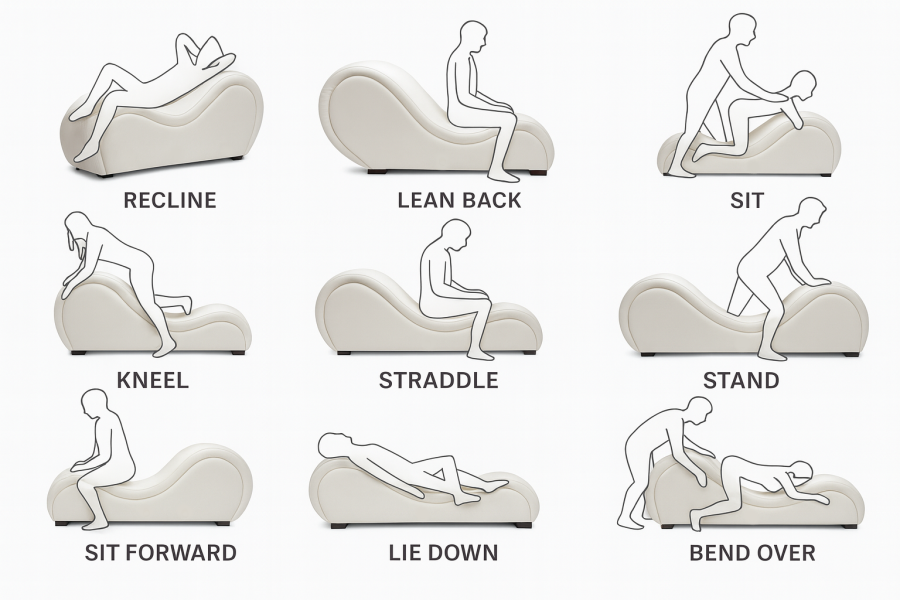
- Sitting: Straddle the apex, soles flat on the floor. The downward slope lets the femur head roll back, naturally untucking the tailbone—same cue physical therapists give desk jockeys for “pelvic tilt neutrality.”
- Kneeling: Slide knees into the lower scoop; ankles rest on the upward curve. You’ve just created a zero-pressure lotus without blowing out cartilage.
- Reclining: Flip supine, shoulder blades on the high end. Gravity opens the chest like those pricey posture-pump gadgets chiropractors sell.
Partner Entry-Level: Start with “assisted child’s pose.” One partner kneels in the scoop; the other stands at the side, palms on the sacrum. The chair’s lip supports the kneeler’s chest so arms don’t fall asleep—no more tapping your partner’s ankle mid-massage like a broken Morse code.
Beginner Flow (10 minutes):
- Two minutes synchronized breathing, seated straddle.
- Three minutes gentle spinal waves—think cat-cow but sexier.
- Five minutes stillness, chest to chest, heart rates syncing. End by noting one sensation in a whisper; research from the Journal of Social and Personal Relationships shows micro-disclosures build intimacy faster than marathon sessions.
Safety Tips and Essential Precautions
Physical: Check the manufacturer’s weight limit—most chairs handle 400 lb (180 kg) but verify before two NFL linebackers decide to reenact the Kama Sutra. Give the frame a “rock test”: lean side-to-side; any creak louder than your grandma’s staircase means tighten bolts again.
Emotional: Create a safe word that’s impossible to mishear. “Red” works; “pomegranate” in the heat of passion turns into “What? Pom-what?” and the moment’s gone. Remember: consent isn’t a one-time checkbox; it’s a live GPS recalculating every moan.
Strain Prevention: If a hip starts chirping like a smoke detector with low batteries, pause. The Mayo Clinic reminds us that sharp pain is a hard stop, not a challenge. Use pillows under knees or forearms to decrease joint torque—same logic as putting a yoga block under a wobbly triangle pose.
Common Beginner Mistakes and How to Avoid Them
Mistake 1 – Sprinting the Marathon: Expecting instant simultaneous orgasms is like assuming you’ll deadlift 225 lb because you watched a TikTok. Tantra is crock-pot, not microwave. Schedule 30-minute slots; end with a cuddle to train your brain for “reward equals slow.”
Mistake 2 – Slouchy Sushi Roll: A rounded back compresses lumbar discs and turns breathing into a shallow puddle. Imagine a string lifting the crown of your head—yes, the same cue your yoga teacher repeats for a reason.
Mistake 3 – Mime Mode: Staying silent to “be spiritual” breeds resentment. Neuroscience shows vocal feedback activates the anterior cingulate cortex, the empathy hub. Translation: talk, and your partner’s brain literally grows closer.
Mistake 4 – Pain Tunnel Vision: Discomfort is data, not defeat. Rate it 1–10; anything above 5 gets adjusted. Period.
Benefits of Incorporating a Tantric Chair into Your Practice
Physical: The 30-degree pelvic tilt common to most chairs mimics the angle urologists at UCLA Health recommend for reducing pelvic-floor tension, which can ease everything from menstrual cramps to post-prostate-surgery rehab.
Emotional: A 2022 Guardian feature on tantra workshops found 78 % of couples reported “higher relational satisfaction” after four weeks of chair-based practices—attributed largely to synchronized breathing and sustained eye contact.
Spiritual: By supporting the body, the chair frees attention to hover in what mindfulness geeks call “open monitoring”—a state correlated with increased alpha-wave activity on EEG, the same rhythm linked to creativity and reduced anxiety.
Advanced Tips for Enhancing Your Experience
Breathwork 2.0: Try 4-7-8 breathing (inhale 4, hold 7, exhale 8) while one partner traces fingertips along the other’s ribcage. The extended exhale stimulates the vagus nerve, shifting you from fight-or-flight to feed-and-breed.
Props: A silk eye mask ups the ante on proprioception—when vision is gone, the somatosensory cortex lights up like Times Square, making every exhale feel like a warm breeze.
Sensation Play: Alternate between a chilled jade roller and a warmed basalt stone along the inner thighs. Temperature contrast activates separate A-delta and C nerve fibers, essentially giving your nervous system a bilingual conversation in pleasure.
Ritual Integration: End by journaling three sentences—same protocol positive psychologists use to cement “micro-moments” of connection into long-term memory.
Frequently Asked Questions (FAQs) for Beginners
How often? Start with once a week; think of it as date night with furniture. Ramp up only if your body writes thank-you notes, not complaint letters.
Solo okay? Absolutely. The chair is basically a gym for self-love—no spotter required.
Uncomfortable feels? Pause, breathe, name the emotion out loud. Research from the APA shows affect labeling reduces amygdala reactivity—translation: saying “I feel vulnerable” literally calms the brain.
Cleaning? Wipe vegan leather with a 70 % isopropyl spray; avoid bleach unless you want your bedroom smelling like a public pool.
Relationship goals? Great for addressing mismatched libidos—low-desire partner can receive non-genital touch first, lowering the stakes.
Learn more? Start with “Urban Tantra” by Barbara Carrellas—modern, inclusive, and blessedly free of cringe euphemisms.
Resources and Further Reading
Books:
- Urban Tantra, Second Edition – Carrellas.
- The Art of Sexual Ecstasy – Margo Anand.
- Come As You Are – Emily Nagoski (for the neuroscience of arousal).
Websites & Communities:
- Tantra Essence – global calendar of certified workshops.
- Planned Parenthood’s Pleasure section – free, medically vetted info.
- Reddit’s r/tantra – peer Q&A (grain of salt included).
Finding Teachers: Look for certifications from the American Association of Sexuality Educators, Counselors & Therapists (AASECT) or the Somatica Institute—both maintain searchable directories.
Conclusion: Embarking on Your Journey with Confidence
Think of your Tantric chair as a passport, not a destination. It won’t magically download enlightenment, but it will hold your hips while you scout the terrain. Approach each session like you’re taste-testing gelato: small spoonfuls, note the flavors, go back for the ones that make your eyes widen. Stay curious, stay kind to yourself, and remember—the best explorers pack patience, lube, and a sense of humor. Happy reclining.