The Weight of a Single Question
“Am I big enough?” “Is my apartment too small?” “Do I earn enough for someone to take me seriously?” Whether whispered in the dark or muttered while doom-scrolling, the question “Does size really matter?” is the Swiss-army knife of modern anxiety—it slices, dices, and haunts every corner of life. This article tackles the elephant (and the tape measure) in the room, separating cultural myths from evidence-based truths about physical and metaphorical size—from the bedroom to the boardroom—so you can swap insecurity for strategy and build a self-image that actually fits.
Part 1: Understanding the “Size” Question in Intimacy
Defining the “Size” Conversation in Sexuality
When people whisper about “size,” they’re usually eyeing penis length, girth, breast volume, or some other metric that can be measured with a ruler or bra tag. Pop culture fuels the fixation: porn labels tout “monster” appendages, while tabloids crown celebrities with “best bust” awards. The result? A 2020 Journal of Sexual Medicine survey found 68 % of men worry they’re “below average,” even though most participants fell well within the typical range.
Scientific & Medical Perspectives on Physical Size
Here’s the anatomical cheat sheet: the clitoris has 8,000+ nerve endings, the vaginal front wall (where G-spot nerves cluster) responds more to pressure than depth, and the most sensitive part of the penis is the frenulum—none of which require a jumbo anything. A Mayo Clinic summary of 15 studies found zero correlation between penis size and partner sexual satisfaction. Translation: biology isn’t grading on length.
Beyond Physical Dimensions: The True Drivers of Satisfaction
Skill, rhythm, creativity, and attunement to a partner’s cues beat raw inches every time. Emotional safety—knowing you won’t be mocked for queefs or awkward angles—lets blood flow to the right places (fun fact: arousal is vascular, not architectural). And nothing turbo-charges pleasure like talking: a 2021 Kinsey Institute report showed couples who used “I like when you…” language during sex reported 40 % higher orgasm consistency.
Common Myths vs. Evidence-Based Realities
Myth: “Bigger equals more orgasms.” Reality: A Healthline meta-analysis shows consistent clitoral stimulation—manual, oral, or toy-assisted—predicts orgasm 90 % of the time, regardless of penetration dimensions. Myth: “Porn star sizes are average.” Reality: The average erect length in the U.S. is 5.16 in (13.1 cm), while many male performers self-report 7–8 in after enhancement tricks—lighting, angles, and editing.
Addressing Body Image and Performance Anxiety
Size fixation hijacks the brain’s threat-detection circuitry, flooding you with cortisol—the anti-Viagra hormone. Quick reset: during intimacy, shift attention from how you look to how you feel. Try the 5-4-3-2-1 grounding trick: name 5 things you can touch, 4 you can see… you’ll be too busy noticing sensations to host a self-critique.
Part 2: “Size” in the Broader Context of Life
Societal Obsession with Scale: Height, Wealth, Status
Swipe through any dating app and you’ll see “6 ft+ only” next to salary brackets and square-footage boasts. Corporate ladders equate corner offices with success, while McMansions sprout like supersized mushrooms after rain. The message: if you’re not upgrading, you’re downgrading.
Does Bigger Always Mean Better? Reassessing Value
Enter the law of diminishing returns: once basic needs are met, each extra bedroom or zero on the paycheck adds less joy. A 2022 APA study found happiness plateaued at incomes around $100 k in high-cost U.S. states; beyond that, life satisfaction flat-lined. Meanwhile, tiny-house owners report lower eco-guilt and higher savings rates—proof that quality of design can outclass sheer footage.
The Psychology of Size Perception
Humans are pattern-seeking mammals; our ancestors sized up predators at a glance. Today that wiring makes us conflate height with leadership: CEOs in the S&P 500 average 6 ft, taller than the 5-ft-9 U.S. male mean, notes a NPR breakdown of corporate data. Marketers weaponize this instinct—think “king-size” candy bars—because bigger packages trigger reward centers primed for surplus.
Finding Value Beyond Measurement
What scales can’t capture: reliability, wit, empathy, the way you remember a friend’s coffee order. In the long run, character compounds like interest. Emotional intelligence predicts relationship longevity five times stronger than income, according to a 2020 NAMI relationship survey.
Part 3: The Impact of “Size” Perception
Psychological Effects on Self-Esteem and Well-being
Constant comparison is a treadmill set to sprint. Instagram’s algorithm feeds you the 1 % of highlight reels, birthing what researchers term “relative deprivation,” a reliable predictor of depressive symptoms. Over time, the brain encodes “I’m not enough” as a default pathway, fueling anxiety and compulsive spending to “catch up.”
Navigating Social Pressures and Comparisons
Family BBQs morph into interrogations: “Still renting?” “When will you settle down?” Social pressure externalizes the size narrative, making Thanksgiving feel like a LinkedIn audit. Buffer tactic: rehearse a “good-enough” script—“We’re happy where we are, thanks”—then redirect: “Pass the mashed potatoes!” Boundaries taste better than grandma’s gravy.
Impact on Relationships and Dating Dynamics
Filtering partners by height or salary narrows the pool to a puddle. Research from the Kinsey Institute shows couples matched on values report 30 % higher relationship stability than those focused on external metrics. Translation: shared humor beats shared shoe size.
Media Influence: How Advertising and Pop Culture Shape Ideals
From truck ads promising “dominance” to reality TV mansions, media sells a super-size fantasy. Behind the scenes: wide-angle lenses make apartments look palatial, and “million-dollar listings” often include inflated valuations for drama. Teach yourself to spot the fisheye—literally and metaphorically.
Part 4: Navigating “Size” Realities: A Practical Guide
Focusing on What You Can Control
You can’t stretch bones, but you can stretch hip flexors. Regular exercise boosts endothelial function, improving blood flow for stronger erections and rosier skin. Master a skill—guitar riff, pasta recipe, Excel macro—and you’ll accumulate what economists call “specific capital,” a far rarer asset than height.
Cultivating Self-Acceptance and Body Positivity
Mirror exercise: stand clothes-free, find three body parts you genuinely appreciate—maybe shoulders that carry groceries, ears that hear birds—and say them aloud for 30 days. Neuroimaging shows repeated self-affirmation activates the brain’s reward circuitry, rewiring self-schema over time.
Communicating Openly in Intimate Relationships
Try the “I like / I wish / I wonder” framework: “I like when you go slow, I wish we could use more massage, I wonder how toys would feel.” It frames desires as collaboration, not critique, lowering defensiveness and raising experimentation.
Prioritizing Quality, Function, and Fit
Apply the wardrobe principle to life: owning ten well-cut basics beats a closet of ill-fitting fast fashion. Translate to careers—better to excel in a niche you love than drown in a bloated role that drains you.
Seeking Professional Support When Needed
If mirror avoidance, compulsive measuring, or sexual avoidance last more than six months, consult a certified sex therapist or a APA-licensed psychologist. Early intervention for body dysmorphia improves recovery rates by 60 %, per NIMH data.
Conclusion: Redefining What Matters
Size is the ultimate red herring—flashy on the surface, hollow at the core. Evidence shows satisfaction—sexual, emotional, existential—springs from responsiveness, creativity, and values, not rulers or bank statements. So trade the tape measure for a treasure map charted by curiosity, kindness, and experiences that fit you. Because in the grand ledger of life, the only dimension that truly matters is depth.
Frequently Asked Questions (FAQ)
Is there a medically defined “average” or “ideal” size for intimacy?
There’s a statistical average—about 5.16 in erect length for penises and 36 C for U.S. bra size—but no “ideal.” Function and mutual pleasure trump numbers; variability is the norm.
How can I stop comparing myself to others in terms of wealth or status?
Curate your inputs: unfollow accounts that trigger comparison, set personal “enough” thresholds (e.g., savings goal, living space), and practice gratitude journaling to anchor your reference point internally.
My partner is worried about their size. How can I reassure them effectively?
Focus on specific sensations: “I love how you angle just right to hit my front wall.” Concrete feedback validates experience, not hypotheticals, and builds body-specific confidence.
Are there proven techniques to enhance sexual satisfaction that aren’t size-related?
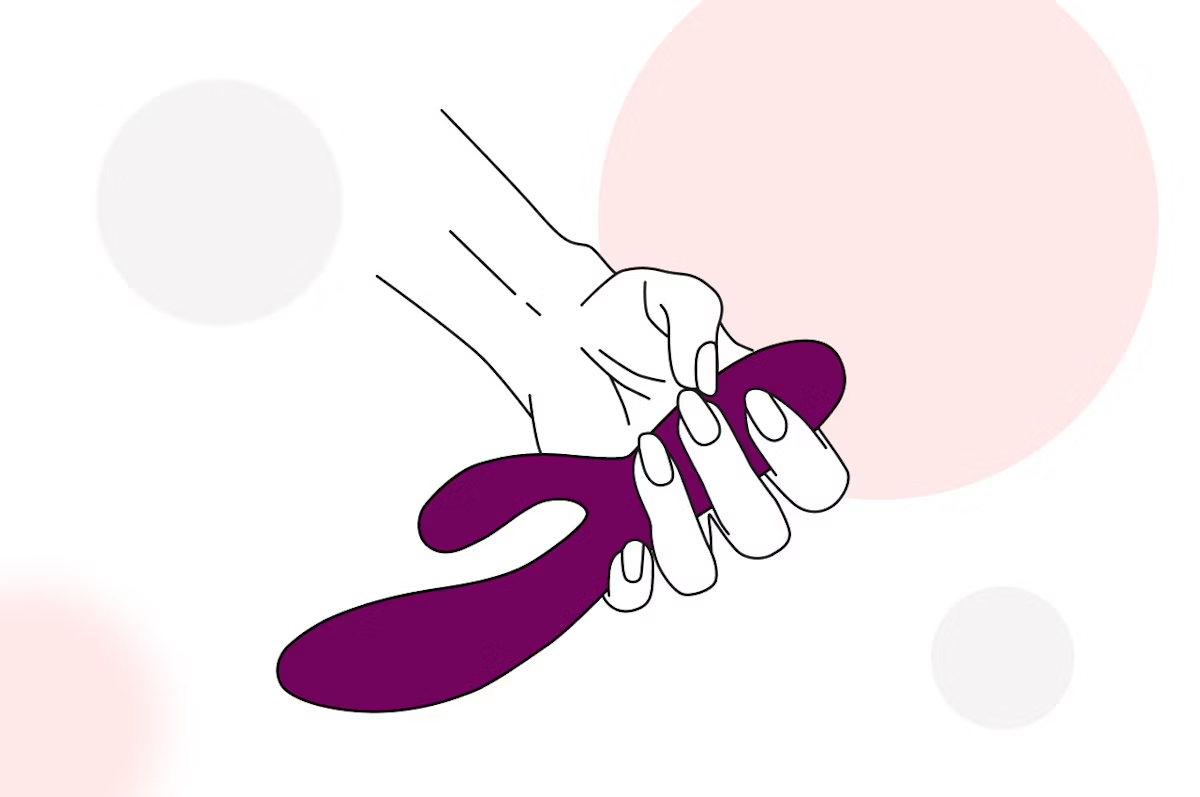
Yes—mindfulness during sex (paying full attention to touch), pelvic-floor exercises for stronger orgasms, and incorporating clitoral or perineal stimulation via hands, mouths, or toys.
When should someone consider therapy for body image issues related to size?
If preoccupation interferes with work, relationships, or causes significant distress (e.g., avoiding dating, repeated measuring, depressive moods), seek assessment from a licensed mental-health professional.
Resources & Further Reading
Authoritative Websites for Sexual Health:
Authoritative Websites for Mental Health & Body Image:
- National Alliance on Mental Illness (NAMI)
- The Body Positive
- American Psychological Association (APA)
Recommended Books:
- Come as You Are by Emily Nagoski (for intimacy)
- The Gifts of Imperfection by Brené Brown (for self-acceptance)
Crisis Support:
If distress becomes overwhelming, call or text the 988 Suicide & Crisis Lifeline (U.S.) or use the Crisis Text Line by texting HOME to 741741.