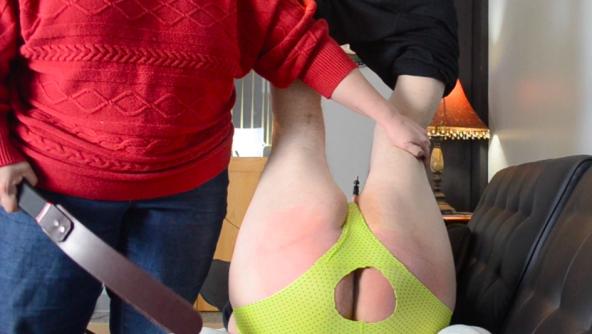
Picture the classic diaper-change pose—hips hinged, knees tucked toward the ears, soles skyward—only now the “changing table” is a padded spanking bench, the “baby” is a consenting adult, and the “wipe” is a well-aimed paddle. Welcome to the Legs Up Spank: Mastering the Diaper Position for Impact Play, a configuration that folds the bottom partner into a compact, highly exposed package. Done right, it concentrates every swat on the meatiest part of the glutes, amplifies sting without extra force, and delivers a delicious hit of psychological exposure. Done wrong, it can torque hips, bruise bone, or leave someone feeling more “ER visit” than “erotic bliss.”
This guide is for players who already know their way around a safeword and want to level-up from “that looked hot on Pornhub” to “I can land 47 strikes in a row within a 2-inch radius while my partner giggles in subspace.” We’ll lean on the same principles surgeons use—precision, safety checks, and anatomical respect—then lace them with the flirtatious energy of a late-night podcast. Expect practical drills, quick-release tricks, and a few dad-joke metaphors involving IKEA furniture. Ready to fold, aim, and fire responsibly? Let’s get those legs up.
I. Core Mechanics of the Diaper Position
1.1 Anatomical Alignment: Visual Guide to Basic Positioning
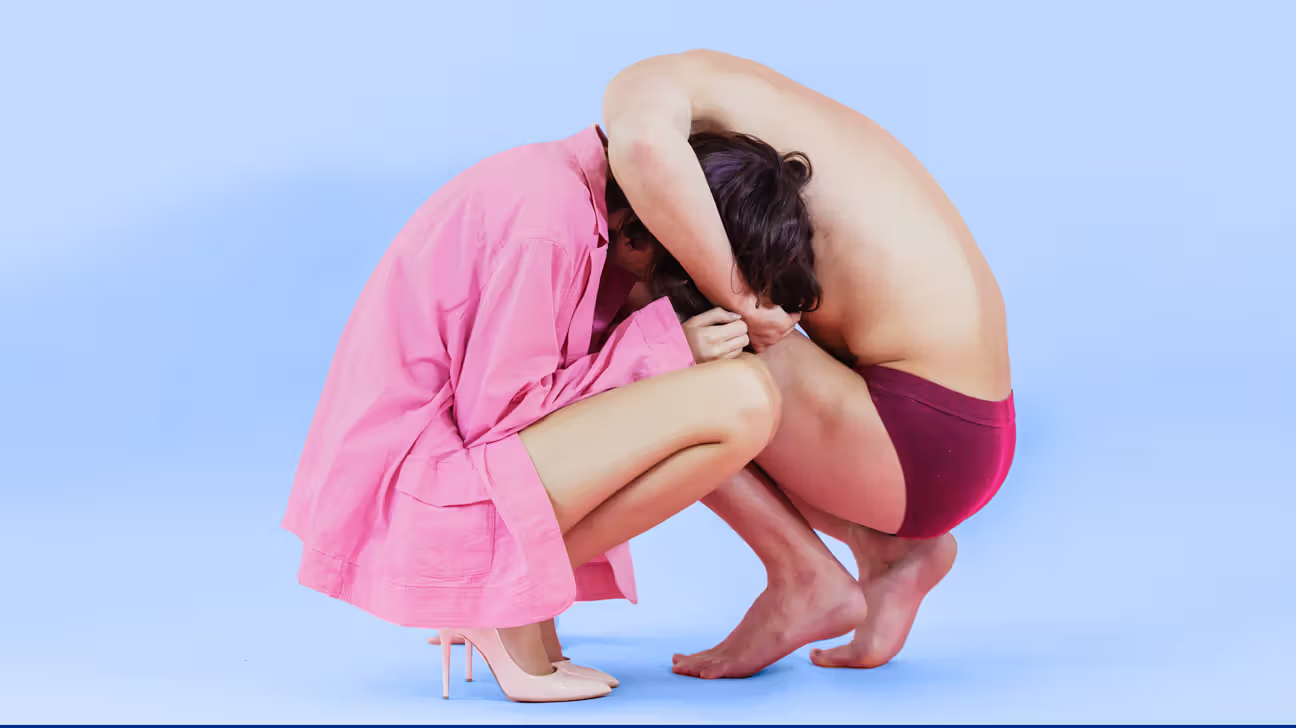
Think of the torso as the base of a tripod, the thighs as the second leg, and the lower legs as the third. All three segments should meet at gentle—not forced—angles. The sacrum (that flat plate of bone just above the tailbone) stays flat on the surface; if it lifts, the hip flexors hyper-contract and the sciatic nerve gets cranky. Slide a folded towel under the hips until you see a straight line from the knees to the shoulders when viewed from the side. Bonus: that micro-lift tilts the glutes upward, presenting a plumper target and reducing the chance of tailbone strikes.
1.2 Biomechanics: Leg Elevation Angles and Impact Force Transmission
Lift the legs too high (knees past the ears) and you turn the glutes into a trampoline—energy bounces off instead of sinking in. Too low (45° or less) and you expose the fragile back of the thigh where the sciatic nerve runs like a commuter rail. The sweet spot is 60–75° hip flexion. At that angle, the gluteus maximus is stretched, fascia is taut, and the underlying bone is cushioned by muscle. Translation: you get that satisfying “thud” without the “crack” that rattles teeth.
1.3 Load Distribution: Protecting Knees/Hips in Restrained State
Wide ankle cuffs look sexy, but if they’re clipped to a suspension bar overhead, all the body weight funnels through the knee. Instead, use two anchor points: cuffs at the ankles and a supportive strap behind the knees. The knee strap carries roughly 60 % of the load, sparing the hip joints and letting the bottom relax into the stretch. Pro tip: slip a neoprene knee sleeve under the strap—your partner will thank you around minute twelve.
II. Impact Play Techniques Optimization
2.1 Tool Selection: Hand vs. Rigid vs. Flexible Implements
Your hand is the Tesla of impact toys—intuitive, eco-friendly, and packed with sensory feedback. Start every session with a bare-hand warm-up; blood rises to the surface like tourists to a beach, prepping skin for heavier artillery. Rigid tools (wooden paddles, acrylic bats) deliver high-frequency sting and leave sharp edges of color—perfect for short, intense bursts. Flexible tools (leather straps, rubber quirts) wrap and distribute force over time, creating deep “thud” and slower bloom bruises. Rotate through the trio like a chef cycling between sear, roast, and rest.
2.2 Stroke Mechanics: Short-Arm Swing Accuracy Drills
Forget wild baseball swings; think drumstick control. Stand perpendicular to the bench, elbow tucked, forearm acting as a piston. Practice on a couch cushion with a target circle drawn in chalk. Your goal: ten consecutive strikes inside the circle without moving your feet. Once you can do it eyes-open, repeat blindfolded—muscle memory doesn’t care about your peepers. When you graduate to human skin, you’ll land within a credit-card-sized zone, minimizing accidental kidney kisses.
2.3 Intensity Progression: Warm-up to Peak Impact Protocols
Map each scene like a Spotify playlist: start mellow, build energy, drop a bass line, then taper. Minute 0–3: light hand taps at 30 % force. Minute 3–6: increase to 50 %, layer in dual strikes (both cheeks). Minute 6–9: introduce a paddle at 60 %, alternate cheeks in a syncopated rhythm. Minute 9–12: peak at 80 % force, three-strike volleys with 5-second pauses to read breathing. After the crescendo, drop back to hand caresses—nerve endings are on fire and the endorphin faucet is wide open.
III. Risk Mitigation Framework
3.1 Danger Zones: Sacrum/Kidney/Sciatic Nerve Protection Protocols
The sacrum is like the motherboard of the pelvis—strike it and you risk bone bruise or worse, a coccyx jolt that can ache for months. Stay at least two finger-widths above the gluteal fold. Kidneys hide under the lower ribs but can dip slightly in deep hip flexion; avoid any contact above the belt line. Sciatic nerve? It emerges at the midpoint of each cheek and travels down the back of the thigh; keep impact medial (inner half) or lateral (outer half) but never dead center unless you’re using a broad, padded surface.
3.2 Distress Cues: Interpreting Involuntary Physiological Responses
A safeword is Plan A, but bottoms sometimes lose speech. Watch for the “three Bs”: blanching (skin turns white, indicating blood-flow shutdown), breath-holding longer than five seconds (vagal response), and ballistic movement (jerky, uncontrolled flails). If you spot any, pause, drop the toy, and place a warm palm on the lower back—grounding pressure resets the vagus and restores words faster than you can say “red.”
3.3 Emergency Release: Quick-Exit Restraint Fail-safes
Carabiners beat padlocks here. Use screw-gate carabiners with a double-action twist—secure under tension, yet one-handed release in under two seconds. Color-code straps: red for knee support, black for ankle cuffs. In dim lighting you’ll know exactly which strap to cut or unclip. Keep EMT shears on a lanyard around your neck, not across the room next to the lube. Seconds matter when a charley horse morphs into a panic attack.
IV. Psychodynamic Enhancement
4.1 Psychological Leverage: Vulnerability/Embarrassment Dynamics
The diaper position infantilizes without age-play ever entering the chat. Exposed genitals, inability to close the legs, and eye contact that screams “I see you seeing me” trigger a cocktail of adrenaline and oxytocin—scientists call it the “social intimacy bump.” Lean in: narrate what you see (“Your skin is blooming like a peach”) to amplify self-awareness. The more specific the observation, the deeper the blush.
4.2 Auditory Feedback: Modulating Vocal Responses for Psychological Effect
Ever notice how a well-timed “Good girl/boy” can feel like a third strike? Match your cadence to their exhale: command on the exhale, impact on the inhale. The brain pairs the praise with the sensation, conditioning arousal. If your partner is a stoic mute, encourage micro-feedback—one finger tap for “more,” two for “edge,” closed fist for “pause.” Over time the taps become a Morse code of pleasure.
4.3 Duration Management: Subspace Induction through Positional Endurance
Subspace isn’t magic; it’s endorphin overdose. Keeping the legs elevated past the five-minute mark taxes the hip flexors, flooding muscles with lactic acid. The brain reads that burn as stress and dumps endorphins to compensate. Safely ride the wave by checking in every 90 seconds with a simple “Color?” If they answer “greenish-yellow,” lighten the strikes but keep the position—endorphins are still climbing.
V. Advanced Scenario Engineering
5.1 Prop Synergy: Anal Plugs/Vibrators for Enhanced Muscle Reactivity
A medium-sized plug does two things: it presses against the internal side of the pelvic floor, making each external strike reverberate, and it reminds the bottom to clench, pumping blood into the glutes. Add a low-profile vibrator taped to the perineum; the constant buzz keeps the pelvic floor fluttering, so muscles never fully relax—meaning every swat lands on a semi-tensed target, amplifying sensation without extra force.
5.2 Thermal Play Integration: Contrast Stimulation Techniques
Alternate a chilled glass wand (10 °C) across the sit spots for 30 seconds, then follow immediately with a hot paddle (warm it under a heating pad to 40 °C). The rapid temperature switch confuses thermoreceptors, temporarily boosting nerve conduction speed. Result: the next five strikes feel 30 % stronger even though you haven’t upped the swing. Keep a towel handy—condensation plus leather equals slip-n-slide.
5.3 Multiple Top Coordination: Spatial Positioning and Rhythm Synchronization
Two tops? Think jazz duet, not dubstep battle. Assign quadrants: Top A owns the upper glutes, Top B the lower. Establish a 4/4 count with A on beats 1 and 3, B on 2 and 4. Stand on opposite sides to avoid friendly-fire. Use mirrored footwork—if A steps forward on the strike, B steps back—keeping both tops visible to the bottom’s peripheral vision, which reduces disorientation and maintains trust.
VI. Post-Session Care Protocol
6.1 Capillary Assessment: Contrast Compress Rotation Method
After intense play, capillaries can leak like over-soaked sponges. Apply a warm compress (40 °C) for three minutes to vasodilate, then swap to a cold pack (10 °C) for one minute to vasoconstrict. Repeat the cycle three times. The pump action flushes out heme pigments, reducing next-day bruise size by up to 40 %, according to sports-medicine guidelines used by Mayo Clinic physios.
6.2 Tactile Recalibration: Progressive Desensitization Exercises
Impact temporarily scrambles the somatosensory cortex’s map of the butt. Restore it with graded touch: start with a silk scarf, progress to cotton, then denim, then bare palm pressure. Ten slow strokes of each fabric retrain nerve endings, preventing the post-scene “numb cheek” phenomenon and restoring normal sitting comfort within an hour.
6.3 Orthostatic Hypotension Prevention: Gradual Position Transition
Legs-up compresses the inferior vena cava; sudden drop to standing can tank blood pressure and cause a fainting spell. Reverse the fold slowly: lower legs to 45° for 30 seconds, then feet flat on the bench for another 30, then seated upright, then standing. Offer a salty snack—pretzels work—to boost plasma volume. Think of it as the cool-down lap after a sprint; skip it and dizziness is almost guaranteed.
VII. Frequently Asked Questions (FAQ)
Q1: What is the safest way to restrain the legs in this position?
Use a two-point system—ankle cuffs plus knee straps—with quick-release carabiners. Avoid suspension unless you’ve taken a dedicated rope-suspension course; the hip angle is already extreme without adding body weight.
Q2: How do I differentiate between “good pain” and a dangerous nerve strike?
Good pain feels thuddy, warm, and spreads slowly. Nerve pain is sharp, electric, and shoots down the leg or up the spine. If your partner says “it’s zingy” or you see sudden foot drop (toe drag), stop immediately and check for numbness.
Q3: Can this position be adapted for partners with mobility issues or chronic pain (e.g., lower back)?
Yes. Place a wedge or stack of pillows under the sacrum to reduce hip flexion. Keep knees loosely bound rather than forced to the chest, and limit session length to five-minute bursts. Consult a WebMD-verified stretching routine beforehand to warm hip flexors.
Q4: What are the best aftercare practices specific to intense, prolonged sessions in this position?
Contrast compress cycles, gentle hip-flexor stretches (cobra pose), arnica gel massage, and a high-protein snack to aid muscle repair. Add verbal reassurance—the diaper pose can trigger vulnerability hangover.
Q5: How do I communicate and negotiate trying this position with a new partner?
Use the “Yes-No-Maybe” list: list the position, restraints, toys, and psychological phrases. Exchange lists, circle mutual interests, and set a 1–10 intensity scale. End with a safeword and a post-scene debrief scheduled within 24 hours.
VIII. Resources & Further Learning
Recommended Reading: Playing Well with Others by Harrington & Williams for scene negotiation; Anatomy of Movement by Blandine Calais-Germain for biomechanics geeks.
Authoritative Organizations: Check free videos at Kink Academy, safety articles from the National Coalition for Sexual Freedom, and workshops at The Eulenspiegel Society in NYC.
Academic References: A 2022 paper in the Journal of Sexual Medicine found consensual BDSM increases stress resilience—summarized nicely by Healthline. For sports-injury parallels, see the NHS guide on gluteal contusions.
Professional Guidance: Seek instructors certified through the American College of Sports Medicine or recognized rope-suspension schools. A weekend intensive beats a lifetime of “oops” bruises.
Conclusion
Mastering the Legs Up Spank: Mastering the Diaper Position for Impact Play boils down to four pillars: fold with precision, strike with intent, monitor like a lifeguard, and cuddle like a golden retriever afterward. Treat each scene as a living lab—hypothesize, test, debrief, iterate. Your partner’s bliss (and beautifully symmetrical bruises) will be the peer review you need. Now grab those carabiners, warm up your drum-arm, and go make some safe, consensual music on the world’s juiciest bongo—the human butt.