I. Introduction: The Art of Crotch Rope Bondage
Google “macramé for grown-ups” and you’ll get wall hangings. Google “Crotch Rope BDSM: Techniques, Variations & Sensual Control” and you’ll land on something far more intimate—and a lot more fun. At its simplest, a crotch rope is a length of cord that passes between the legs and is secured to the body so that every breath, step, or wiggle translates into delicious (or devious) stimulation. Think of it as wearable remote control: the top owns the volume knob, the bottom supplies the soundtrack.
People reach for crotch rope for four big reasons: sensation (hello, walking vibrator), restriction (legs together, mind blown), psychology (power exchange in one tug), and aesthetics (Shibari fans, you know the glow-up a well-placed knot gives a hip line). Whatever your flavor, the non-negotiables are the same as ordering a latte—state your needs, confirm consent, and make sure nobody gets burned.
II. Understanding Crotch Rope Fundamentals
Before you go full Spider-Man on someone’s junk, memorize the real estate. The pudendal nerve cruises through the perineum like a busy commuter; compress it too long and your partner’s “yes, yes, yes” can flip to “numb, numb, numb.” Add in delicate mucous membranes and you’ve got skin that’s basically the facial under-eye of the pelvis—thin, absorbent, and quick to protest.
Key vocab: “bight” (the fold at rope midpoint), “tension” (how hard you pull), “lock-off” (the knot that keeps things where you left them), and “load line” (the strand that actually carries force). Master those four words and you’ll sound like you graduated Rope Harvard.
Psychologically, a crotch rope is a mobile boundary: it can feel like a secret hug in public or a chastity billboard in private. The brain tags the sensation as both “I’m being touched” and “I’m being held,” releasing oxytocin and a dash of adrenaline. That chemical cocktail is why some bottoms drop into subspace faster with a simple cord than with an entire toy bag.
III. Safety, Risk Awareness & Best Practices (The Paramount Chapter)
Let’s get clinical for thirty seconds. The Mayo Clinic lists nerve compression symptoms as tingling, burning, or sudden loss of motor control—exactly what you don’t want south of the belt. Check circulation by asking your partner to wiggle toes or clench glutes; if either motion weakens, loosen up like you’re untying a rushed sneaker knot.
Red-flag zones: the inguinal canal (where the leg meets the trunk), the clitoral shaft or penile frenulum, and the sciatic nerve that hides under the glutes. Picture these as the rope equivalent of a “do not disturb” door hanger at a hotel—touch only with permission and never leave anything heavy hanging.
Negotiation cheat sheet: duration (start with 10–15 minutes), intensity (on a 1–5 scale, stay at 2 for beginners), and exit strategy (“red” = immediate scissors). Keep EMT shears in your pocket, not across the room; adrenaline turns ten feet into a marathon when someone yells “stop.” Aftercare = hydration, a warm blanket, and a five-minute check-in the next day—same protocol doctors recommend after a brisk 30-minute walk, except you probably burned fewer calories and gained more stories.
IV. Materials & Equipment Guide
Rope is like wine: varietal matters. Cotton is the “house white” of bondage—cheap, washable, hypoallergenic, but it stretches like your motivation on a Monday. Nylon has silky glide and vivid colors, perfect for speed scenes; just beware the heat friction that can feel like a rug burn in micro-bikini territory. Jute and hemp are the craft IPAs: earthy, toothy grip, authentic Shibari aesthetic, but they need conditioning (boiled linseed oil, beeswax, and a weekend you’ll never get back).
Length? Most bodies are happy with 7–8 meters (25–30 ft) folded in half. Diameter: 6 mm is the Goldilocks zone—fat enough to spread pressure, thin enough for intimate knots. And please, for the love of all things orgasmic, buy EMT shears with blunt tips; they cost less than two fancy coffees and can slice through a tensioned rope faster than you can say “safe word.”
Optional bling: 1-inch welded rings (attach a leash or a hitachi wand), lightweight carabiners rated for climbing (overkill is underrated when someone’s weight is involved), and silicone-coated wands that slip under the cord for temperature play—pop them in warm water or the freezer, never microwave unless you want a visit from the burn unit.
V. Core Techniques & Step-by-Step Tying Methods
Prep like a chef: trim fingernails, remove rings, lay out two ropes and shears. Warm-up is non-negotiable—five minutes of hip circles or a quick stretch reduces cramp risk the same way the NHS recommends before a jog.
Fundamental Crotch Harness:
- Find the bight, place it at the small of the back, ends forward.
- Run tails between legs, split around genitals—think dental floss vs. cheese wire.
- Cross over the hip bones, feed back under the waist wrap, lock off with a square knot.
- Adjust tension: you should be able to slide two fingers under the rope, no more, no less.
Diamond Harness Variation: After step 2, create a diamond over the pubic mound by crossing the ropes, then feed each tail under the waist band at opposite sides. The diamond lifts everything into a pretty presentation package—think gift wrap for consenting adults.
Integrating wrists: once the crotch line is stable, extend one tail up to a chest harness and capture wrists behind the back. Keep elbows free; shoulders dislocate faster than you can say “YMCA.”
VI. Exploring Variations & Artistic Styles
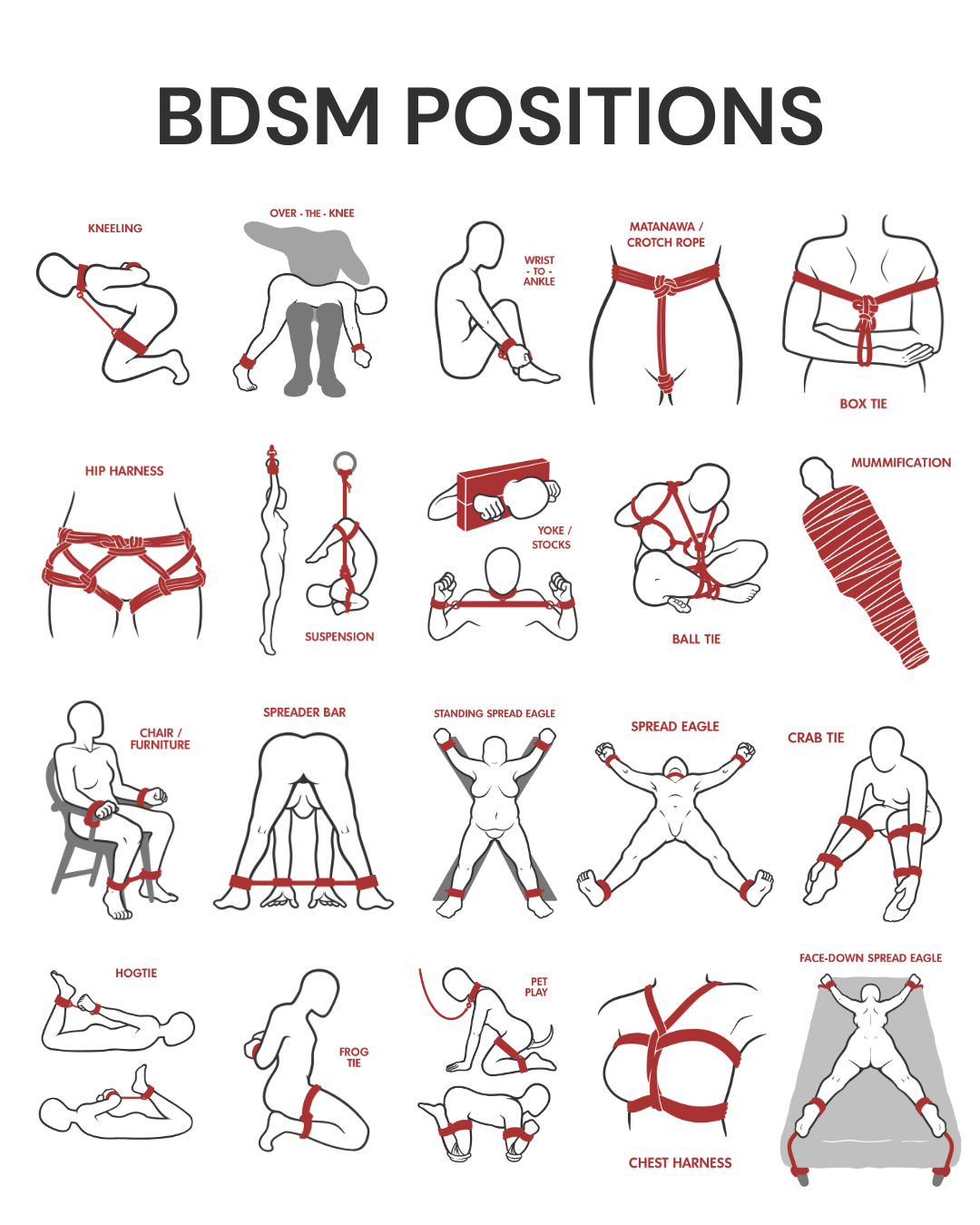
Minimalist lovers can run a single strand under clothes before date night—every barstool shimmy becomes a covert Morse code. Maximalists weave three ropes into a hip harness, leg cuffs, and a decorative Turk’s head that would make a sailor blush.
Gender tweaks: for vulvas, center the rope between labia to avoid direct clitoral pressure unless intense stimulation is negotiated. For penises, angle the cord so the shaft lifts upward; testicle trapping requires extra care—think “snug hammock,” not “vice grip.” Plus-size bodies benefit from wider bands (double the rope, halve the pressure) and higher waist anchors to prevent slippage.
Combine with a shinju chest harness for full-body lattice, or run a line to an ankle cuff to create a “predicament”: stand straight and the crotch relaxes, squat and the rope tightens. It’s the kink version of a wall-sit calorie burner, except the burn is way more fun.
VII. Sensual & Erotic Control Applications
Texture play: drag a chilled silicone wand along the rope; the metal fibers in jute will conduct cold like a kinky thermos. Temperature plus friction equals fireworks. Pressure play: add a simple overhand knot directly over the clitoral hood or scrotal raphe—tiny real estate, massive neural payoff.
Tease & denial: pair the rope with a remote-control plug; allow your partner to walk, not orgasm. Every step reminds them who’s boss. Psychology 101: the rope becomes an external chastity device—no locks needed, just the promise that removal requires the top’s say-so, flipping the usual “access granted” script of penetrative sex.
Scene integration: during impact play, the crotch line holds a vibrator in place while you deliver light flogger taps. The bottom can’t tell if the next sensation will be thud, buzz, or both—uncertainty cranks dopamine. Think of it as the adult version of Netflix autoplay, except you curate every cliffhanger.
VIII. Context, Ethics & Continued Learning
Crotch rope isn’t an island; it’s a spice that flavors the larger stew of rope bondage. Whether you identify with SSC (Safe, Sane, Consensual) or you fly the RACK (Risk-Aware Consensual Kink) flag, the common denominator is informed enthusiasm. A 2021 Kinsey Institute survey found that 65 % of BDSM practitioners felt closer to their partner after consensual kink—communication, not rope diameter, predicted satisfaction.
Keep your education ongoing: follow peer-reviewed educators on CrashRestraint, join local rope munches, and watch at least three different instructors demo the same tie—if they all agree on safety points, you’ve found consensus gold. Remember, YouTube University is great for sourdough, terrible for genital nerves.
IX. Frequently Asked Questions (FAQ)
Q: What’s the safest rope for a beginner?
A: 6 mm cotton or soft nylon. Cheap, washable, forgiving.
Q: How tight?
A: Two-finger rule: slide fingers under the rope; if you have to force it, loosen.
Q: Must-avoid areas?
A: Deep perineal groove, clitoral shaft, penile dorsal nerve, inginal canal.
Q: How long can it stay on?
A: Start with 10–15 min; advanced players may go 30–45 min with regular checks.
Q: First warning signs?
A: Tingling, color change, sudden temperature drop, or the bottom going quiet—silence is a safeword.
Q: Where to learn in person?
A: Search FetLife events for “rope bite” or “peer rope,” or check TheDuchy’s workshop calendar.
X. Resources & Further Reading
Websites: CrashRestraint (free video library), TheDuchy (step-by-step guides), FetLife’s “Rope Safety and Techniques” group.
Books: Shibari You Can Use by Lee Harrington, Better Bondage for Every Body by Evie Vane, SM 101 by Jay Wiseman for overarching safety frameworks.
Educators: Look for local instructors certified by organizations like the International Rope Bondage Exchange (IRBE) or who list “NCSF” (National Coalition for Sexual Freedom) alignment.
Disclaimer: This article is for educational purposes within consensual, risk-aware BDSM. Always obey local laws, prioritize communication, and when in doubt, untie, renegotiate, and hug it out.